Golden Advice on Refits (by Guest Blogger Phil Friedman)

Heading to the Shipyard for a Refit….Avoid Grounding on the Reef of Emergent Work

So, your yacht is headed to the shipyard for a major refit. And you’ve had a pre-job inspection completed and all items covered under a firm fixed-price agreement. Planned, budgeted, and all wrapped up. Well…maybe not, if you haven’t considered emergent work and how it is to be handled once the refit begins.

“Emergent work” is critical work that needs to performed, but the need for which is discovered only after a refit has started. It can involve anything from corroded piping or electrical connections to tank leaks or even structural issues that were not visible until, for example, certain interior joinery panels were removed as part of the refit underway. The important point to understand is that, as any candid shipyard manager will tell you, emergent work is the icing on the refit yard’s cake, when it comes to profit.

The reason is pretty clear. Once a build or refit is underway, the shipyard no longer finds itself subject to the same competitive pressures it felt leading up to the original contract. And if your refit agreement doesn’t detail how emergent work and change orders related to it will be handled and priced, your agreement has a hole in it big enough through which to pilot a superyacht.

Unless a procedure governing acceptance, pricing, and effect on schedule has been established initially as part of your refit agreement, you are open to finding yourself paying for change orders related to emergent work at a unit rate much higher than in your original contract. Moreover, you may be forced to accept unreasonable delays to the scheduled completion/delivery date. And if that scheduled completion/delivery date is linked to plans for a date-sensitive cruise or charter, the true cost of your refit may end up to be much more expensive than you anticipate. So what to do?

The original refit contract should specify clearly an all-inclusive hourly shop rate that is to be applied to emergent work and related change orders. The original contract should also lay out clearly a reasonable and mutually acceptable procedure for calculating any schedule changes that are to ensue as the result of the yard’s accepting the emergent work. And there should also be a detailed procedure for pre-submission of pricing quotes and proposed schedule modifications to the vessel’s owner or his/her representative. Such detail should include specification of definite time periods to be allowed for submission, review, and approval or rejection of change orders related to emergent work.

Dealing effectively with emergent work requires reasonableness on the part both of the shipyard and the yacht’s owner. To avoid unnecessarily delaying a project in mid-stream, consideration should be given to incorporating provisions in the refit agreement to the effect that the shipyard’s work on the yacht shall proceed as normal, subject retroactively to any pricing and schedule modifications ultimately awarded by an agreed upon arbitration procedure. If nothing else, this sort of provision brings significant pressure upon all parties to achieve a negotiated resolution to any disputes involving emergent or change-order work, and avoids unnecessarily delaying the progress of a refit due to a disagreement about the pricing and timing of emergent work.

NOTE: This post is adapted from Phil Friedman’s recently published eBook, Ten Golden Rules for Successful New Build Projects. Comments on the eBook by noted industry professionals have included:

From Stephen Moon (Board Certified Admiralty and Maritime Law Specialist, Stephen M. Moon, P.A., Cocoa, FL, USA): “Your e-book is excellent. I should have been doing a lot of other things this morning but I could not resist reading the e-book as soon as I had a break… Your remarks are very insightful and will be appreciated by many. I have a much better understanding of the events leading up to the actual build process and the  important issues to consider before construction now. Your e-book is a quick, must read for anyone involved in a new build project or major refit.”

Chartering in the Maldives on Luxury Crewed Super Yacht CAPRI

The Maldives is one of the worlds ultimate luxury destinations, perfect for honeymooners, sun worshippers and divers. Consisting of 26 atolls, the Maldives are a series of ancient coral reefs that provide some of the best beaches and waters on earth. The way of life is simple and peaceful, allowing guests to fully relax and enjoy the bright blue skies and yearly sunshine.

Facts and Figures:

360,000 Residents
11,000 Displaced since the Tsunami
27% Live in Malé
90,000 Sq km Area
0 Shark attacks since 1976

The best time to visit Malé is from December with an average temperature of 28 degrees and the lowest precipitation levels, making Christmas the ideal time to visit. Malé is the busiest of all the atolls and the business centre of the Maldives, yet is worth a visit to get a taste for the Maldivian way of life. The numerous bars, restaurants, shops and busy markets create the same buzz that you would find in any other capital city. We would recommend the Whale Submarine for those with children, as it provides a great place to look at the reef and everything that lives below. If you are interested in diving, there are a number of great dive schools and sites just a short boat trip away.

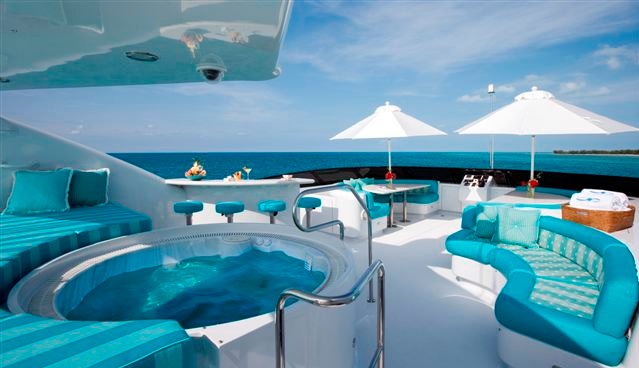
Why not incorporate one of the worlds leading luxury destinations with the one of the worlds greatest experiences – Yachting! One of our favourite Luxury Super Yachts that is available this Christmas is CAPRI, a 58.5m Lürssen with 6 magnificent staterooms, as well as some of the best outdoor entertaining spaces on the market. Her full beam master stateroom is furnished beautifully with a combination of dark wood and cream fixtures and fittings.  The decor in the saloon is much lighter, thanks to full length windows and this minimalistic approach continues on her decks, where guests will find a large jacuzzi with plenty of sunbathing areas. If you are interested in sport, CAPRI features a fully equipped gym, including a multi gym and plenty of water toys for the whole family. She is available in the Indian Ocean this winter, so don’t miss out on the opportunity to charter her in either the Maldives or the Seychelles.

Watch this space for more information on the best places to charter a yacht, including details itinerary plans and recommendations. If you would like to enquire about chartering any of the yachts listed here or before, please follow the links or send an email to [email protected]. We would love to help you organise the experience of a lifetime on board a luxury yacht!


Chartering a Luxury Yacht in the Seychelles, Indian Ocean

The Seychelles is widely known as one of the world’s most picturesque and delightful destinations. The islands are collectively an archipelago in the Indian Ocean, consisting of around 115 islands, most of which are only temporarily inhabited, if at all. The archipelago is made up of two groups of islands, simply named the Inner Islands, and the Outer Islands. The Inner Islands are home to the Seychelles two largest islands, Mahé, which extends 27 km (17 mi) North to South and 11 km (7 mi) East to West, and Praslin. Between these two islands, a shuttle service is offered both by air and on the water.

Spread across 174 square miles is a population of 84,000 (2009 estimate), which makes the Seychelles the 60th most densely populated country in the world. People like to travel to the Seychelles all year round due to it’s constant sun and humidity, but rainfall plays a large factor. The months of December, January and February (to an extent), bring the most rain, where June, July and August are the most dry.

The inner islands offer safe and easy moorings with easy sailing distances. Mahé itself has 44 miles of coastline and over 65 beaches and coves for those wanting to escape the crowds. Our recommendations for scenic locations would include Baie Ternay, Beau Vallon, Anse Soleil and Anse Royale. If secrecy is the name of the game for your charter, you’ll definitely want to head to Anse Jasmin, Anse Du Riz and Petit Anse. From the main island of Mahé, be sure to sail by the twin islands of Cousin and Cousine before continuing to Praslin, which has 18 miles of coastline and plenty of gorgeous hideaways of it’s own.

The outer islands are both less developed and more remote, but hold no less beauty. These islands are more recommended for the experienced sailors and for crew, as the journeys between these islands require an extra amount of effort. The nearest group of Outer Islands to the Inner Islands are the Amirantes, 130 miles southwest of Mahé. The Outer Islands are made up of 5 groups of low-lying coral islands and reefs, which explains it’s difficulty for many a sailor.

Chartering a yacht in the Seychelles is a sure way to relax and take time out of your every day life. We highly recommend the yacht CAPRI, a fantastic 58.5m Lurssen. She is extremely spacious and offers both 6 fantastic cabins for 12 guests, and ample deck space for those guests to enjoy the tranquility of the Seychelles on board a stunning yacht. She is fully fitted with all of the latest equipment, and has her own gym on board. Plenty of water-toys make for a fantastic charter, with wave runners, snorkelling equipment, wake boarding and much more on offer. She has an excellent crew who will be there to meet your every need, making sure that every moment on board is just as (if not more) memorable than the last. CAPRI is available this winter in the Indian Ocean for charter.

If you would like to charter CAPRI for a charter this Winter Period, email us at [email protected]. For more information on chartering a yacht in the Seychelles with the leading online yacht charter broker, please see here.

How to Make a Boat More Fuel Efficient (From Guest Blogger Alan Cairns)

Fuel is one of the main costs involved in running a motorboat, and considering price increases over the last decade, it’s no surprise that fuel costs is one of the main reasons some people decide they cialis 10mg can’t afford to keep a boat anymore. There are some simple steps that we can take in order to use fuel more efficiently, beyond simply driving at a slower speed. This article explores some of the ways of making a motor boat more economical.

Weight

One of the easiest ways to make a boat journey more efficient is to get rid of all that unnecessary baggage. Most boats fill up with clutter over time, and while clothing and bedding for boat crew isn’t going to add a lot of weight to the boat, things like spare parts and tools can add a lot of additional weight. Reducing the weight of the vessel is one of the simplest ways of getting more “bang for your buck” in terms of fuel.

Image

Motor boats can carry a lot of water, which is great for long distance journeys, but reducing the amount of water being carried for shorter journeys can greatly improve fuel efficiency. Just remember all the reasons you will need water on board – hydration, tea-making and washing. Water is even heavier than diesel so only take what you need.

Fuel & Engine

Most boats have the capacity to store enough fuel for extremely long journeys, but on shorter trips it makes a lot of financial sense to half-fill the tank. Calculate how much fuel you need for a particular journey, and add another 10-20% as a precaution.

Engines themselves play an important part in the speed and fuel economy of a boat, especially on faster boats. The engines can be checked relatively easily if the boat is fitted with fuel readout meters. Simply ease back on the throttle, and if this leads to a significant drop in fuel consumption without a drop in speed then it is highly likely that the engine is having difficulty taking in air or fuel. Even if you don’t have readout meters, you can still check that filters are clean. Dirty filters can block fuel flow and impede performance.

Tide & Wind

It might sound obvious, but utilising the tides on boat journeys can greatly reduce fuel consumption. It’s important to ensure that the boat’s speed is well-matched to the tide, otherwise the boat will begin to push a foul tide. Utilising the tide and the wind will make for a cheaper journey, and a better sea state to boot.

Hull Fouling

Marine growth on a boat can lead to a significant impairment of the vessel’s performance. A full scrub of the hull will solve the problem, but sometimes this growth can accrue surprisingly quickly, especially in warm waters. In the Mediterranean some boats won’t plane after being left for just a couple of months due to severe barnacle growth. It’s thought that a lift, scrub and new coat of antifoul can reduce fuel consumption by around 10%.

Trim Tabs

Trim tabs are used to alter the altitude of a boat by raising the stern and dropping the bow. Altering trim tabs can also improve fuel efficiency, as it reduces drag by elevating the stern. It’s something which needs to be observed and tweaked regularly, as too much trim can reduce the speed of the boat if the bow is too low.

Alan Cairns writes on a number of subjects including and caring for an outboard motor.

Watersports on a Luxury Crewed Yacht Charter in the BVI

Whether you wish to try your hand at water-skiing, scuba diving, snorkeling, fishing, knee boarding, windsurfing or Seabobs (among other sports), there are always boats on offer that meet all the necessary water sport requirements. Chartering a crewed yacht with a variety of sea toys is a fantastic way to ensure a family vacation with plenty of excitement and adventure. Below you will find brief descriptions of just some of the fantastic water sport opportunities on offer.

Scuba Diving / Snorkeling

Screen-shot-2012-11-13-at-12.10.07The beautiful waters of the Caribbean are the perfect place for exploration and discovery. Dive down to sites that include the wreckages of Spanish galleons and British warships, or snorkel through the stunning coral reefs that are home to a host of tropical fish and other rare species of marine life.

Many crewed yachts offer diving instructors on board who will ensure that you have a safe and enjoyable scuba-diving experience. Rendezvous diving means that you are joined by a professional diving company who bring their own boat and diving equipment. These companies offer only the most experienced diving staff who have unrivalled knowledge of all the best local dive sites.

As the only coral reef island in the Virgin Islands, Anegada is an extremely popular charter destination for snorkelers and scuba divers.  Other popular diving and snorkeling destinations include the Maldives, Seychelles and the Great Barrier Reef.

Waterskiing, Wakeboarding and Kneeboarding

The easiest and quickest way to learn how to ski is by starting on a kneeboard. Kneeling on the board gives you a much lower centre of gravity than conventional waterskiing, which makes it easier to balance and keep control when you are being towed at speeds of around 30-50km/h.

In contrast, water skiing not only requires exceptional upper and lower body strength but also extremely good balance. Many boats offer both adult and children’s waterskis. Children often find learning to waterski easier than adults due to their lower centre of gravity.

Wakeboarding was originally developed from a combination of water skiing, snowboarding and surfing. Wakeboards are usually made of foam or honeycomb, which is mixed with resin and coated with fibreglass.

Given the obvious dangers of falling into the water at speed, a third person is required as a spotter for the person in the water. The spotter’s job is to ensure that all necessary safety measures are taken.

Interesting fact: The most skiers towed behind one boat is 145. This world record was set by the Horsehead Water Ski Club in Strahan, Tasmania, in January 2012.

Personal Water Craft / Water scooter

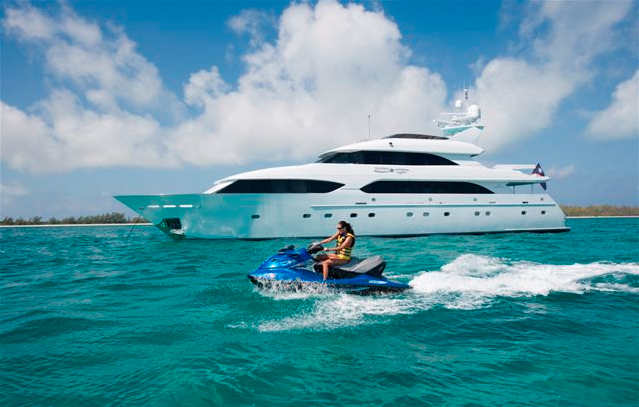
Personal Water Craft (PWCs) are often referred to by their more well-known brand names such as Jet Ski, WaveRunner and SeaDoo. These vehicles are normally designed for one or two people, although three- and four-man models do exist.

PWCs are popular because they are small, very fast and easy to manoeuvre. They are also an extremely fun way to explore the ocean and are safer around swimmers because they do not have external propellers.

Riders should probably try their best not to fall off though, as there is a risk of similar injuries to those that can be picked up on waterskis.

Screen-Shot-2012-12-03-at-14.15.31With accommodation for 6 guests in 2 cabins, the Jongert 27m crewed sailing yacht ICARUS is ideal for sailing charters around Europe and the Virgin Islands. ICARUS offers a variety of exciting water toys including snorkelling equipment, waterskis, tube, towing ring, wake board and fishing gear, while rendezvous diving is also an option.

If you would like some advice and help in planning a trip to the BVI, please  have a look at our BVI Catamaran Charter Guide or send us an email to [email protected], where one of our Brokers would be delighted to assist you.